Newton's Law of Motion
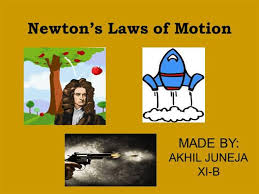
Newton's laws of motion are three physical laws that together laid the foundation for classical mechanics. They describe the relationship between a body and the forces acting upon it, and its motion in response to said forces. They have been expressed in several different ways over nearly three centuries,[1] and can be summarised as follows.
First law:When viewed in an inertial reference frame, an object either remains at rest or continues to move at a constant velocity, unless acted upon by an external force.

Second law:The vector sum of the forces F on an object is equal to the mass m of that object multiplied by the acceleration vector a of the object: F = ma.
Third law:When one body exerts a force on a second body, the second body
simultaneously exerts a force equal in magnitude and opposite in direction on the first body.
The three laws of motion were first compiled by Isaac Newton in his Philosophiæ Naturalis Principia Mathematica (Mathematical Principles of Natural Philosophy), first published in 1687.[4] Newton used them to explain and investigate the motion of many physical objects and systems.[5] For example, in the third volume of the text, Newton showed that these laws of motion, combined with his law of universal gravitation, explained Kepler's laws of planetary motion.


good job...!
ReplyDelete